
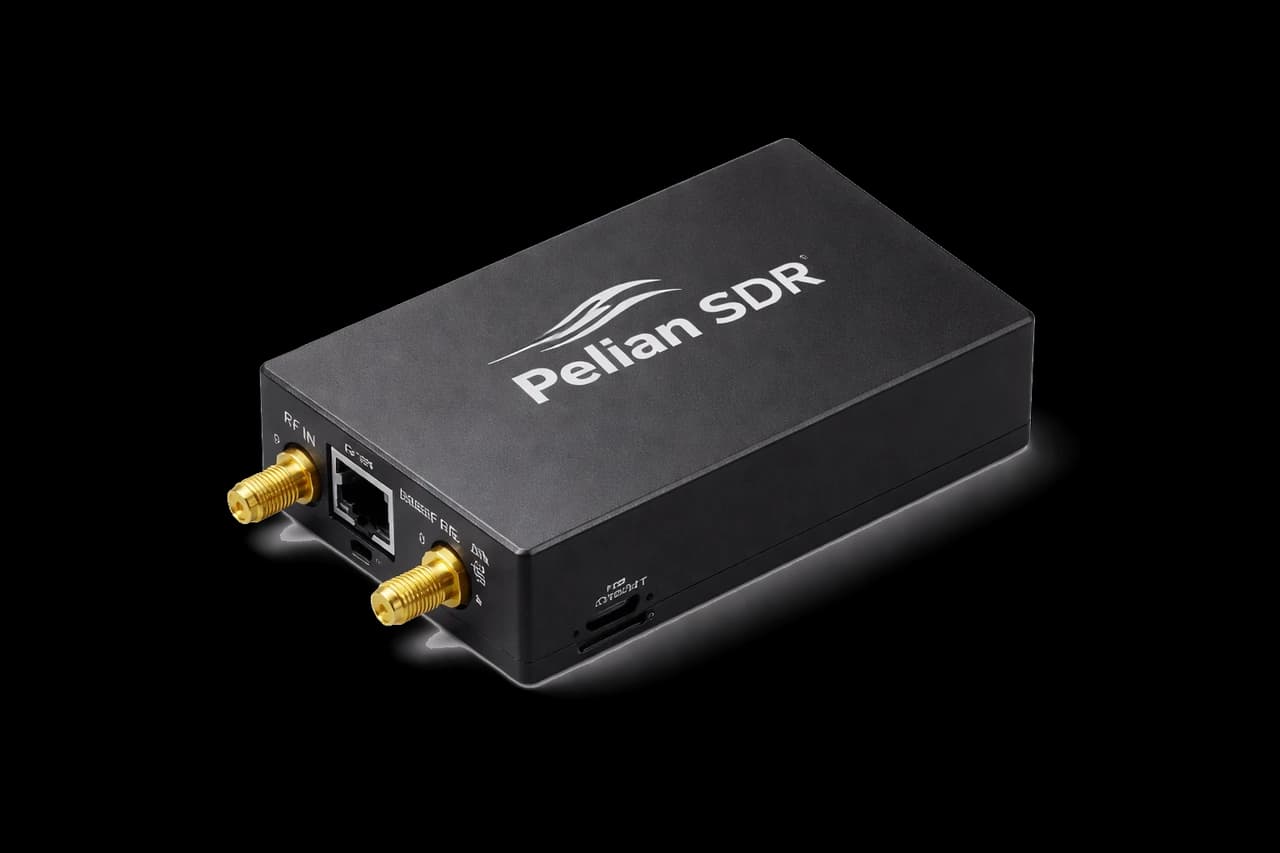
Products / Pelian SDR

Intelligent RF processing for resilient reception.

Two intelligent Software Defined Radio platforms built to suppress interference, condition challenging waveforms and strengthen receiver-side performance.

Product comparison / 02

Two architectures. One resilient signal strategy.

Use the comparison below as an initial selection guide, then discuss your signal environment and integration constraints with Achilles-DS.

Comparison of Pelian SDR PSR100 and PSR500
Selection guidePSR100Robust reception in interference-challenged environments.PSR500Next-generation carrier protection for enterprise satellite infrastructure.
Intended deploymentCompact receiver-side subsystemIndustrial inline infrastructure subsystem
RF architecture1T1R4T4R phase-coherent
Frequency coverage400 MHz–6 GHz1 MHz–7.2 GHz
Instantaneous bandwidthUp to 50 MHz400 MHz per channel
Channels1× RX / 1× TX4× RX / 4× TX
Control and data1 Gigabit Ethernet2× 100 GbE, 2× 10 GbE and 1× RJ45
Physical format95 × 55 × 23 mm compact subsystem1U half-rack
Typical use caseGNSS, TM/TC, laboratory and compact RF integrationWideband satellite infrastructure and multi-channel deployments

Shared technology / 03

A common foundation for intelligent RF conditioning.

01

Intelligent processing

Intelligent methods support interference suppression in dynamic RF environments.

02

Deterministic processing

FPGA signal paths support predictable, low-latency, real-time operation.

03

Inline integration

Subsystem architectures are designed to work with wider receiver and modem chains.

04

RF resilience

Signal conditioning targets improved effective SINR and reception robustness.

05

No added transmit power

Receiver-side conditioning improves reception without requiring increased transmit power.

06

Existing-chain compatibility

Designed to condition waveforms before existing receiver and modem equipment.

Broader portfolio / 04

Connected communication technologies.

Explore the wider public Achilles-DS portfolio across intelligent SDR, connectivity and interference mitigation.

Discuss a technical requirement